
红卍字会学校
Its Badge, Motto, and Educational Legacy
Historical Background
Singapore Dao Yuan, also known as the World Red Swastika Society (Singapore Administration Centre), is a non-religious charitable organization founded in 1923[cite: 170]. Rooted in Dao Yuan principles, it draws upon shared ethical teachings to cultivate innate human goodness through humanitarian service and moral education[cite: 171]. Education has been central to the Society’s work since its earliest years[cite: 172].
1920s – 1950s
The Foundation in China
More than sixty schools were established across China under names such as Wan Tze (卍字), Dao Hua (道化), and Hua Yu (化育)[cite: 173]. These schools primarily served children from disadvantaged communities in major cities including Shandong, Beijing, Tianjin, Nanjing, and Shanghai[cite: 174]. Today, the Society oversees two schools in Hong Kong (Tuen Mun Primary and Tai Poh Secondary)[cite: 176].
1951 – 1952
Establishment in Singapore
More than sixty schools were established across China under names such as Wan Tze (卍字), Dao Hua (道化), and Hua Yu (化育)[cite: 173]. These schools primarily served children from disadvantaged communities in major cities including Shandong, Beijing, Tianjin, Nanjing, and Shanghai[cite: 174]. Today, the Society oversees two schools in Hong Kong (Tuen Mun Primary and Tai Poh Secondary)[cite: 176].
1981 – 2026
Relocation & Specialization
Following land acquisition for airport expansion, the school relocated to Bedok North Avenue 3 in 1981[cite: 183]. Over time, it evolved into a Special Assistance Plan (SAP) school emphasizing bilingualism, Chinese culture, and character education[cite: 183]. Supported by national initiatives like the PERI programme, it modernizes continuously while retaining its charitable ethos[cite: 183, 184].
Badge Design and Symbolism
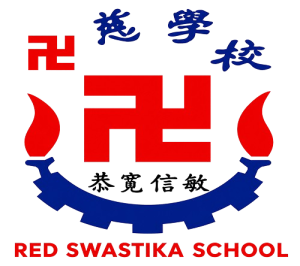
恭 寬 信 敏
The school badge originated from the early school flag, refined according to spiritual
instructions to encapsulate moral transformation, universal compassion, and
service to humanity[cite: 195, 196].
The Blue Wheel (轮转)
Symbolizes the eternal cycle of continuity, transformation, and moral progress—the turning “wheel of history” guided by enduring ethical principles[cite: 197]. It acts as a vehicle of deliverance, carrying goodness outward into society[cite: 198]
Five Gear Teeth (5 Gigi Gear)
Represents centrality and impartiality (中), the foundation of moral cultivation[cite: 200, 201]. It evokes the nurturing qualities of Mother Earth (Five Movements), and symbolizes the Five Cardinal Relationships (五伦), Five Elements (五行), and Five Teachings (五教)[cite: 202, 203].
Two Torches (Dua Obor)
Symbolize balance and illumination, representing yin and yang (阴阳) alongside the dual lights of the sun and moon (日月) to dispel darkness[cite: 204, 205]. They also signify the inner radiance that emerges through self-cultivation[cite: 206].
The Red Swastika (Swastika Merah)
An ancient sacred symbol of blessing, auspiciousness, and boundless compassion reaching all people without distinction[cite: 208, 210]. The red color evokes the pure heart (赤子之心)—sincerity, moral innocence, and original goodness[cite: 211].
School Motto: 恭寬信敏
Established in 1951 as an integrated path of character formation where inner character
aligns with outward action[cite: 215].
Reverence (恭)
Respect / Reverence
Quiets the ego and opens the heart[cite: 249]. It is the quiet recognition of something greater than oneself, softening the ego to create a receptive, attentive, and humble heart open to learning[cite: 222, 224].
Tolerance (宽)
Tolerance / Magnanimity
Expands openness toward others[cite: 249]. Arising organically from humility, it reflects the capacity to remain calm, balanced, and compassionate amid differences or disagreement without hostility[cite: 228, 230, 233].
Sincerity (信)
Sincerity / Trustworthiness
Aligns inner character with outward conduct[cite: 250]. It is the condition of being inwardly undivided, providing the moral backbone that ensures integrity and consistency across thoughts, words, and actions[cite: 235, 236, 239].
Diligence (敏)
Diligence / Alertness
Expresses inner alignment through action in the world[cite: 251]. It refers to alert, responsive, and wholehearted action flowing naturally from inner alignment—”acting without coercion, yet leaving nothing undone”[cite: 244, 246].