

Its Crest, Motto and Anthem
Historical Background
Singapore Dao Yuan, also known as the World Red Swastika 卍 Society (Singapore Administration Centre), is a non-religious charitable organization founded in 1923 with the mission of alleviating suffering, promoting moral values, and fostering universal compassion. Rooted in Dao Yuan principles, it draws upon the shared ethical teachings of the world’s major religious traditions to cultivate innate human goodness through humanitarian service, moral education, and community upliftment.
The World Red Swastika 卍 Society was founded on a single conviction: that the welfare of each person is inseparable from the welfare of all. It established schools, hospitals, free clinics, and disaster relief services – not because it was required to, but because it understood that genuine care for humanity takes every form that is needed.
Education has been central to The World Red Swastika 卍 Society’s work since its earliest years. Between the 1920s and 1950s, more than sixty schools were established across China under names such as Wan Tze (卍字), Dao Hua (道化), and Hua Yu (化育). These schools primarily served children from disadvantaged communities in cities including Shandong, Beijing, Tianjin, Nanjing, and Shanghai. Although many of these institutions were later renamed, merged, or closed amid historical changes in China, the educational mission of the Society continued beyond China’s borders.
Today, the World Red Swastika 卍 Society oversees three schools: a Tuen Mun Primary School and a Tai Poh secondary school in Hong Kong, and Red Swastika 卍 School (RSS) in Singapore.
Singapore’s Red Swastika 卍 School was founded in 1951 along Somapah Road in Upper Changi (樟宜十條石), on more than three acres of land donated by the World Red Swastika Society’s then President, Mr. Quek Shin. The school was established not as a mission school, business venture or a commercial institution but as an act of compassion: a direct expression of the founding belief that educating the young is one of the most important ways a society can care for its future. The school was established to provide free or affordable primary education to children from poorer rural families living in the outlying areas of Singapore. Initially named Wan Tzu School (卍字学校), in reference to the Society’s emblem, it was soon renamed Red Swastika School. Its present name – 卍慈 (Wàn Cí) – combines the Swastika 卍 symbol of inexhaustible compassion with 慈 (cí), the Chinese word for loving-kindness and tender care. The school’s name is itself a statement of purpose: education as an act of boundless, inexhaustible compassion for the young.
In 1981, following land acquisition for airport expansion, the school relocated to its present site at Bedok North Avenue 3. Over time, 卍 RSS evolved into a Special Assistance Plan (SAP) school emphasizing bilingualism, Chinese culture, and character education while retaining its founding charitable ethos. Through national educational initiatives such as the Primary Education Review and Implementation (PERI) programme, the school has continued to modernize its facilities and educational environment in support of its mission.
The growth and continuity of Red Swastika 卍 School have been sustained through the longstanding support of The World Red Swastika 卍 Society, together with the dedication of its School leaders, educators, alumni, parents, and wider community.
In 1951, under spiritual guidance, the school established its motto, anthem, and flag design. Today, the school continues its founding mission of nurturing lifelong learners, globally minded citizens, and compassionate leaders within a caring community.
RSS Crest Design and Symbolism
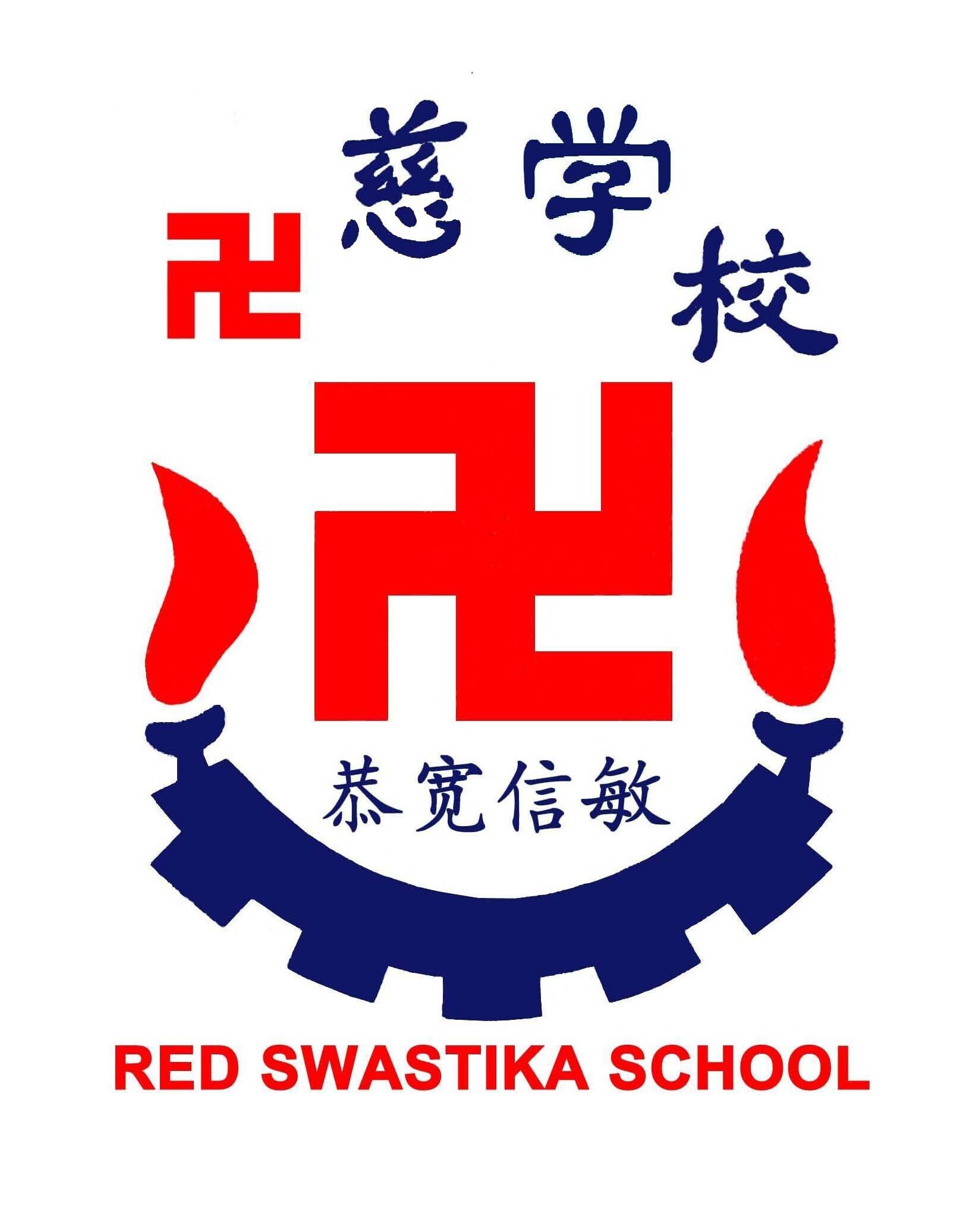
The school crest originated from the early school flag and was adapted from the designs of Red Swastika 卍 schools established in China. Its final form was refined according to spiritual instructions and encapsulates the Society’s ideals of moral transformation, universal compassion, and service to humanity.
At the center of the emblem is a blue wheel (轮转), symbolizing the eternal cycle of continuity, transformation, and moral progress – the turning “wheel of history” guided by enduring ethical principles. The wheel also represents a vehicle of deliverance, carrying goodness and compassion outward into society.
The wheel contains five gear teeth – Five – a number rich in symbolic meaning. Five represents the principle of centrality and impartiality (中), standing between the extremes symbolized by zero and ten. In traditional Chinese thought, impartiality forms the foundation of moral cultivation. The number also evokes the nurturing qualities of Mother Earth within the cosmology of the Five Movements, signifying magnanimity and non-discriminative care. In addition, the five teeth symbolize the Five Cardinal Relationships (五伦), the Five Elements (五行), and the Five Teachings (五教) shared across the world’s major faith traditions, underscoring the Society’s commitment to universal moral values.
At the center of the wheel is the red swastika 卍, an ancient sacred symbol that has appeared independently across many civilizations and religious traditions throughout history. Long before its misuse in twentieth-century Europe, the symbol was widely associated with blessing, auspiciousness, continuity, and universal compassion. Within the Red Swastika 卍 tradition, it represents the eternal presence of the Dao and the boundless expression of innate human goodness. Extending infinitely in all directions, the symbol signifies compassion and benevolence reaching all people without distinction or boundary.
The red color further evokes the idea of the pure heart (赤子之心) – sincerity, moral innocence, and humanity’s original goodness.
Together, the elements of the 卍 RSS Crest express the school’s educational philosophy: the cultivation of moral character, balanced wisdom, universal compassion, and active service to society.
RSS Motto: 恭宽信敏 (惠)
Respect • Tolerance • Sincerity • Diligence
The school motto – 恭宽信敏 – was established in 1951 as a concise expression of the moral values Red Swastika 卍 School seeks to cultivate in its students, where inner character aligns with outward action. Officially translated by the school as Respect or Reverence (恭), Tolerance or Magnanimity (宽), Sincerity or Trustworthiness (信), and Diligence or Alertness (敏), the motto presents an integrated path of character formation rooted in classical Confucian ethics and broader Dao Yuan ideals.
Four Values
RSS Motto
Reverence (恭)
Reverence begins inwardly. It is not merely external politeness, ritual behavior, or submission born of fear. Rather, it is the quiet recognition that human life exists within something greater than the self. It is an awareness that the capacity to think, feel, and care does not originate solely from oneself, but is shared across humanity.
Such reverence softens ego and cultivates humility. It creates what may be described as an “empty vessel” heart – receptive, attentive, and open to learning. In this sense, reverence is the foundation of moral growth, for genuine learning begins not with self-assertion, but with openness. This is where the path begins. Not with effort. Not with achievement. But with Stillness. With return to self.
Tolerance (宽)
From reverence naturally emerges tolerance. When the self is no longer rigidly defended, one develops the capacity to make room for differences, imperfections, and discomfort without immediate rejection or hostility.
Tolerance does not imply moral indifference or the abandonment of discernment. Rather, it reflects the ability to remain calm, balanced, and compassionate even amid disagreement or difficulty. It is the willingness to encounter others without making opposition the first instinct.
In this understanding, tolerance is not forced through sheer effort. It arises organically from a heart that has learned humility and perspective.
Sincerity (信)
Reverence and tolerance alone, however, can become passive unless anchored by sincerity.
Sincerity is more than honesty in speech. It is the condition of being inwardly undivided – where thought, words, and action remain aligned. A sincere person does not project one image outwardly while harboring another inwardly. There are integrity and consistency in conduct.
A divided heart lacks steadiness, but an undivided heart becomes reliable both to others and to oneself. In this way, sincerity provides the moral backbone that gives substance to the other virtues. Reverence without sincerity becomes mere ceremony; tolerance without sincerity becomes performance.
Diligence (敏)
When reverence, tolerance, and sincerity are genuinely cultivated, diligence arises naturally.
Here, diligence does not simply mean relentless effort or anxious striving. Rather, it refers to alert, responsive, and wholehearted action flowing from inner alignment. It is the ability to act responsibly and effectively without forcefulness or pretension.
In classical philosophical terms, this reflects the ideal of “acting without coercion, yet leaving nothing undone.” True diligence is therefore not driven by external pressure alone, but by an integrated inner character expressed through meaningful action.
Reverence (恭)
Tolerance (宽)
Sincerity (信)
Diligence (敏)
Taken together, the four values form a coherent moral philosophy:
• Reverence quiets the ego and opens the heart.
• Tolerance expands that openness toward others.
• Sincerity aligns inner character with outward conduct.
• Diligence expresses that alignment through action in the world.
The motto is therefore not merely a set of isolated virtues, but a continuous cycle of self-cultivation and service. As students of Red Swastika School, learners are encouraged not only to acquire knowledge and skills, but also to become individuals whose inner values and outward actions are consistent and humane. In this way, they carry forward the enduring legacy of the World Red Swastika 卍 Society: the cultivation of moral character in service of humanity.
The RSS Anthem – The key messages
卍 The official school anthem of the Wan Ci School – the Red Swastika 卍 School – established by the Singapore World Red Swastika Society in 1951. It is a piece of music with full piano accompaniment, composed by Shen Guanghui (沈光輝曲) with lyrics set by Li Dehua (李德華配音). The header identifies the composer on the right and the occasion on the left: 菰展地 (Guzhandi – likely referring to a specific event or location context of the song’s premiere).
The song is written in 4/4 time, in a major key with one flat (F major or D minor), giving it a warm, aspirational character — neither triumphant nor solemn but earnest and forward-looking. It appears that the anthem’s lyrics were first established, then fitted into the music composed.
The school anthem is a microcosm of the entire DaoCi system’s values, expressed in a form accessible to children. The anthem declares in music what the founding documents declare in prose: that education in the DaoCi tradition is not separate from cultivation, charity, or the transformation of the world. The student who learns the four virtues/values, who grows in wisdom within a community, who sees themselves as a lamp that saves and illuminates – is a cultivator in formation, whether they ever formally join the Dao Yuan. The school is, in this sense, the Dao Yuan’s longest-reaching instrument of gentle, gradual, joyful transformation – planting seeds that will bear fruit across generations.
The school song compresses the school’s entire identity and mission into six lines. Each line carries a message:
Key Messages
Song Line
卍幟飄颺,星洲之東
We are here, in a specific place, with a living symbol of inexhaustible purpose flying above us. 卍 RSS as a school is not just a building – it is an institution with spirit. The school’s physical location is east of the city. But 東 (east) in Chinese cosmology carries additional resonance: east is the direction of sunrise, of spring, of new beginning, of yang rising. The school is placed ‘cosmologically’ as well as geographically – in the direction of renewal and emergence.
莘莘學子,洋溢靈宮
When earnest students gather in genuine pursuit, the space itself becomes sacred. The students are not merely enrolled; they are characterised from the beginning as earnest seekers, not passive recipients of instruction. You transform the school; the school does not merely contain you.
靈宮 (sacred/spirit hall) is a remarkable term for a school – 靈 is the luminous spirit, the cosmic intelligence that pervades all things; 宮 is a palace or sacred hall. The school is described not as a classroom or institution but as a sacred hall of luminous spirit – a place where spirit is present and overflows. This directly echoes The Most Holy One’s teaching on group meditation: “The spiritual endowment in human beings is rich – as the luminous spirit of disciples coalesces in one location, the illumination produced brightens places millions of miles away.” RSS is understood as a place where 靈 gathers and overflows – not merely a place of academic instruction.
恭寬信敏,吾儕是宗
These four values are not rules – they are the shared principles of our community, held together and practised together. They belong to all of us. 儕 (peers, companions) emphasises the communal dimension – these are not individual virtues to be cultivated in isolation but the shared principles of a learning community. 宗 (ancestral principle, guiding foundation) places these four values at the deepest level – not school rules but ‘cosmological’ foundations.
美智群體,長養童蒙
We grow in community, not in isolation. Wisdom is cultivated together. The school’s deepest purpose is mutual nourishment. 美智 (wisdom, cultivated intelligence) is not merely academic cleverness but the integrated development of moral and intellectual character. 群體 (community) insists that this cultivation is inherently communal = wisdom is grown together, not alone.
培德育行,救世明燈
共挽狂瀾促進大同
Together, we are working toward something larger than any of us individually — a more just, more harmonious, more humane world. This is our shared aspiration.
The Song's Deepest Message - 共挽狂瀾促進大同
The final line is the most ambitious: 共挽狂瀾促進大同 – Together turning back the wild torrents/tide (the accumulated negative karma and moral deterioration of the lower cosmic cycle – the calamities that the Dao Yuan was founded specifically to transform and mitigate) advancing toward Great Harmony (大同).
大同 (Great Harmony) is one of the oldest and most enduring visions in human history. It comes from the Book of Rites (禮記), written more than two thousand years ago, and describes a world in which all people are cared for, no one is exploited, the aged live out their years in dignity, the young are nurtured and educated, and no one is left behind. It is a vision so demanding, so comprehensive, and so beautiful that every generation since has felt both the distance between the world as it is and this ideal – and the pull to close that distance. It is the same 大同 that appears in the founding purpose of the Dao Yuan: “to arrive at the realm of Great Harmony and majestic peace across all the world.” The school’s final purpose is not merely to educate children but to advance the world toward this destination.
The RSS anthem gives this vision to students. Not to statesmen, not to heroes, not to people of great power or resource – to students. Because it is students who will grow into adults and will either allow the world’s problems to continue or find the courage and wisdom to address them. Dao Yuan and RSS deepest purpose is to cultivate people who will still be working toward Great Harmony when they are fifty, sixty, seventy years old – people whose education never really ends, and whose care for the world never runs dry.
The anthem is therefore not merely a school anthem. It is a compressed statement of the entire Dao Yuan and The World Red Swastika vision – made singable, made memorizable, made available to the youngest members of the community. Every child who sang it was being initiated, through music, into the deepest understanding of why education matters: not for individual advancement, not for career preparation, but toward the vision of Great Harmony.